Govern AI at runtime.
Enforce policy before it executes.
Enterprise buyers no longer ask whether your AI is governed. They ask what it did — which model ran, whose data it touched, which region it stayed in — and they ask you to prove it. PolicyGate answers that at runtime: every AI request is checked against policy before it executes, and every decision is recorded with a cryptographic signature.
Sub-10ms decisions · OpenAI-compatible drop-in · Cryptographic audit trail
Deployed at the edge. Evaluated before execution. Auditable by default.
What It Is
What PolicyGate is — and what it isn't
What it is
A runtime enforcement point.
It sits between your applications and LLM providers, and evaluates every request before it executes.
An evidence layer.
Every decision — allowed or denied — produces a signed, exportable record.
Independent of the system it governs.
That separation is what makes the evidence credible to an auditor.
What it isn't
Not an agent or workflow platform.
No orchestration, no node editor, no scheduler — it governs the calls your platform makes.
Not a content filter or guardrail.
It does not judge what a model says; it governs whether the request may execute at all, and records the decision.
Not a proxy for observability tooling.
Logs describe what happened; PolicyGate decides what is permitted, then proves it.
Explainer
See it in 46 seconds
The Problem
LLM traffic runs outside enterprise security boundaries.
No runtime policy enforcement
There is no control plane between enterprise applications and external LLM providers. Requests execute without policy evaluation, access control, or governance checks of any kind.
Policies don't exist in the request path
Acceptable use policies, data handling constraints, and provider restrictions are documented but unenforced. Nothing intercepts a violating request before the model processes it.
No data sovereignty at the call level
Regional compliance requirements—GDPR, EU AI Act, MENA data residency—cannot be enforced without routing controls operating at the AI request layer, not the application layer.
Governance gaps stall enterprise deals
Six-figure deals get blocked at procurement when security can't get clean answers about access control, residency, and audit. Average delay: three to six months. Many never close.
Architecture Overview
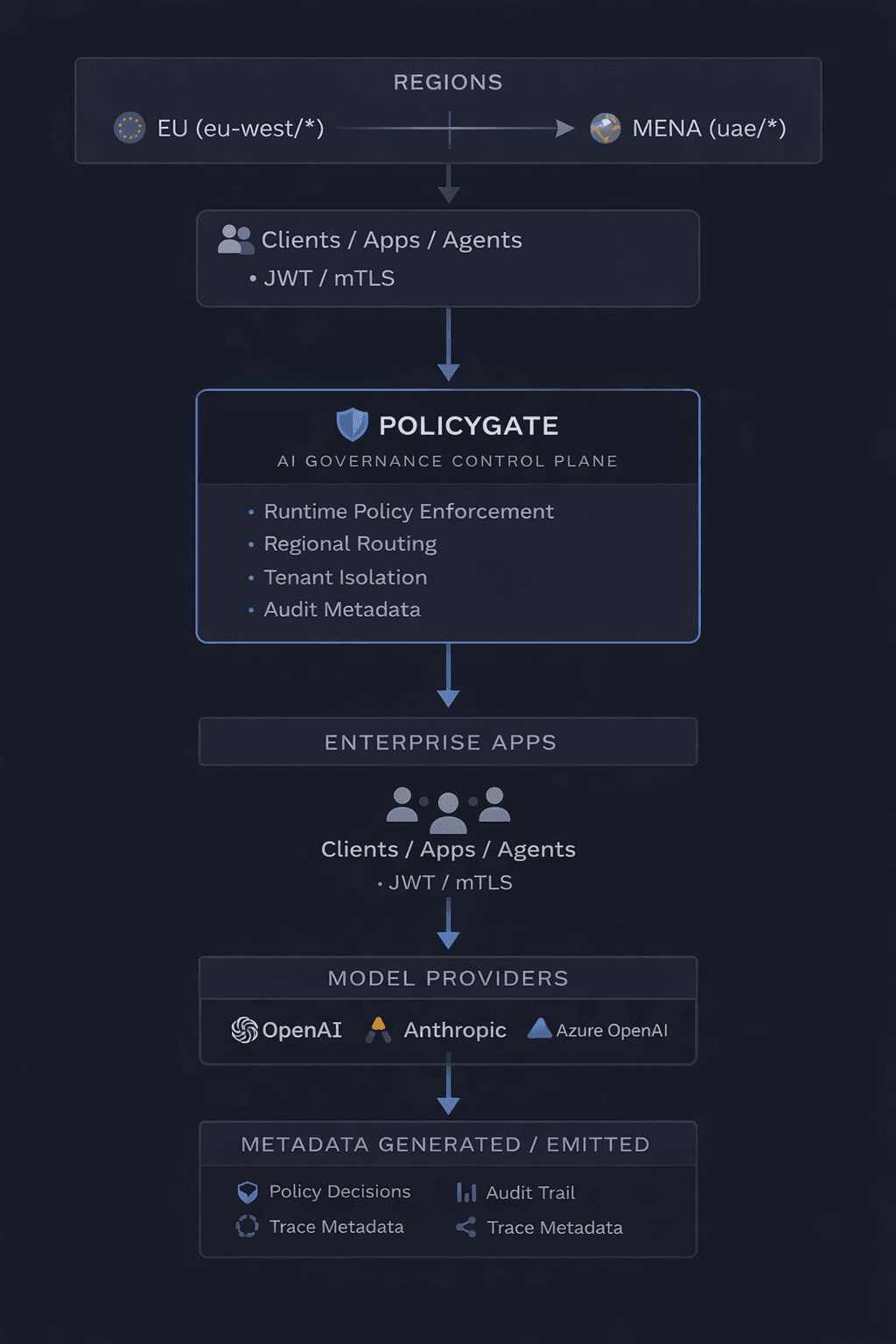
PolicyGate operates as a control plane in the AI request path.
PolicyGate sits in the request path between your applications and AI providers. Every request is verified, governed, and routed through a single control plane — generating signed audit records that your compliance team can hand to enterprise customers and regulators alike. Same architecture from MENA edge to EU edge — regional sovereignty enforced at the request level.
Live Operations
STANDBYOperating right now.
Real decisions from the deployed PolicyGate stack — updated every 30 seconds.
Decisions evaluated
Last 24 hours
p50 latency
p95 latency
Metrics temporarily unavailable
How It Works
PolicyGate inserts a governance control plane into the AI request path.
Edge termination on every LLM request
PolicyGate terminates AI requests at the edge before they reach a provider. All traffic—streaming or synchronous—passes through the control plane for evaluation, tagging, and routing.
Policy evaluated before every request executes
Every request is evaluated against your governance policies before reaching the provider. Access control, tenant boundaries, data residency, model gating, and provider restrictions — all enforced in the request path, not after the fact.
Region-aware routing with egress control
Requests are routed to compliant provider endpoints based on tenant context, data classification, and regional policy. EU and MENA traffic never exits designated boundaries without explicit policy authorization.
Cryptographic record on every decision
Every decision produces a cryptographically signed, tamper-evident record. The request, the policy version that evaluated it, and the outcome — all linked by a unique decision ID. Drop it into your audit log.
Security & Compliance
For security and compliance leaders
The questions your customers' security reviewers ask — and where the answers come from.
Which AI models can our data reach?
Model allowlists enforced per tenant at request time. A call to an unapproved model never executes.
Where does inference happen?
Regional routing enforced as policy, not configuration. Requests that would leave the approved region are denied, and the denial is recorded.
Who authorized this AI action?
Every request carries a verified identity and scope. Anonymous or over-permissioned calls are refused before execution.
Can you prove any of it, months later?
Every decision is signed at the moment it is made and exportable for any date range — evidence, not reconstruction.
Answering these in a vendor questionnaire is the difference between a stalled deal and a signed one.
Build vs. Buy
Why not just build it?
Teams with strong platform engineering often build a control layer internally. Here is what that layer usually cannot do.
Self-attestation.
A control layer built inside the system it governs is the system vouching for itself. Auditors discount that everywhere else; AI will not be the exception.
Evidence format.
Producing records is easy; producing records an external auditor accepts — signed, complete, tamper-evident, exportable per request — is the hard part, and it is not the fun part to maintain.
Drift.
Internal layers track the product's needs, not the regulator's. Obligations change; a dedicated enforcement point is where that change gets absorbed.
PolicyGate is deliberately narrow: it does one thing, outside the system it governs, so the evidence means something.
Capabilities
Infrastructure-grade controls across the entire AI request lifecycle.
Runtime Policy Enforcement
Policies are evaluated against every AI request at execution time. Requests that violate policy are blocked or redirected before reaching the provider — sub-10ms decisions on real customer traffic.
OpenAI-compatible drop-in
Any application already written against the OpenAI SDK routes through PolicyGate without code changes. No SDK updates, no client rewrites, no integration effort.
Regional & Sovereignty Controls
Enforce EU, MENA, and custom regional routing rules at the gateway level. Data residency requirements are satisfied at the infrastructure layer, not the application layer.
Multi-Tenant Isolation
Strict tenant boundary enforcement across policy namespaces, routing rules, and audit streams. Tenant context propagates through the full request lifecycle.
Signed Decision per Request
Every request carries a cryptographically signed policy decision record. Tamper-evident, version-bound, attributable to the exact policy that ran. Audit-ready out of the box.
Full Audit & Observability
Tamper-evident audit trail of every AI request: policy decisions, routing choices, provider responses, and enforcement outcomes. Queryable by request, tenant, and region.
Egress Governance
Provider egress is explicitly permitted by policy. No application reaches OpenAI, Anthropic, Gemini, or any other provider without a current, valid policy authorization for that tenant and use case.
Live Conformance Suite
See every governance check execute against the deployed stack — one click. Eleven scenarios covering happy path, missing scopes, residency mismatch, expired credentials, unknown routes, and more. Real decisions, real audit trail, no mocks.
Who It's For
Built for the teams who own enforcement, not just oversight.
CISOs
Extend enterprise access control to AI infrastructure. Enforce zero-trust policy, provider egress control, and audit requirements at the gateway—without depending on application teams to implement controls.
AI Platform Teams
Operate a centralized AI access layer across all applications and business units. Control which models, providers, and capabilities are accessible, and enforce consistent policy without modifying application code.
Enterprise Architects
Integrate AI governance directly into existing security infrastructure. PolicyGate operates as an infrastructure component—sitting in the request path alongside API gateways, service meshes, and observability pipelines.
Compliance & Risk Leaders
Demonstrate enforceable controls at the AI request level. Every LLM call produces a policy decision record. Regional routing constraints are enforced in infrastructure, not asserted in documentation.
AI-native Companies & ISVs
You sell into Fortune 500s. Their procurement teams hand you a 200-question security questionnaire about your AI stack. Your engineers shouldn't have to build governance from scratch every time. PolicyGate is the governance layer between your product and your customers — deploy it once, hand them the report.
From the Founder
“Every enterprise we worked with was running LLMs in production with no policy enforcement in the request path. Governance existed in documents—acceptable use policies, data classification frameworks—but nothing was enforcing them at runtime.
PolicyGate is the control plane that sits where enforcement actually matters: between the application and the model. Policy evaluation happens before the request executes. Audit records are produced at the infrastructure level. Enforcement is architectural, not procedural.”
PolicyGate Team
Architecture Briefing
See how PolicyGate fits your infrastructure.
We work with a limited number of enterprise teams in early deployment. Share your details and an engineer will follow up within 48 hours to discuss your environment and architecture requirements.